Custom work enjoys a reputation that it doesn't deserve. Clients ask for it because they believe their organisation is unique. Providers offer it because they believe it demonstrates expertise. The result is a marketplace in which nearly everyone assumes that tailoring creates better outcomes. My own view has changed over time. I once believed that custom work made clients and participants happier because it reflected their specific situation. Experience convinced me otherwise. The closer I looked, the clearer it became that custom work solves far fewer problems than people imagine while creating many new ones that remain invisible until the work has already begun.
The central argument of this essay is straightforward: fixed-scope offers outperform custom work in far more situations than people realise because they reduce uncertainty, make expertise easier to understand and purchase, and allow knowledge to improve through repetition. Custom work should be the exception rather than the default. The widespread preference for bespoke services says less about the actual complexity of organisations than about how people perceive their own circumstances.
This argument is not a rejection of expertise. It is an argument about where expertise produces the greatest value. Professionals spend their careers adapting themselves to every client’s request. The irony is that this flexibility often prevents their expertise from maturing into something consistently valuable.
The first misunderstanding concerns the problem itself. Clients do not buy custom work because their challenges are genuinely unique. They buy it because their context feels unique to them. Those are not the same thing.
Every organisation has its own vocabulary, reporting lines, software landscape and internal politics. These differences are immediately visible, so they dominate conversations during sales meetings. Beneath that surface, however, the underlying problems repeat with remarkable consistency. Teams struggle with priorities. Managers communicate expectations poorly. Subject-matter experts know their field but struggle to transfer knowledge. Meetings produce decisions that disappear into notebooks. New employees receive information without understanding how everything fits together.
The scenery changes. The script doesn't.
That becomes difficult to ignore after working across dozens of organisations. Different logos appear on the building. Different templates decorate the PowerPoint slides. Someone proudly explains why this organisation is unlike any other. Within a few hours the same behavioural patterns emerge again. Information remains fragmented. Processes have grown around exceptions. People compensate with goodwill until goodwill becomes exhaustion.
This leads to a useful way of separating what deserves customisation from what does not. Every professional service contains three layers:
- The underlying principles.
- The delivery method.
- The local examples and language.
The first layer should almost never change. Good principles remain good principles regardless of industry. The second layer benefits from standardisation because repetition improves quality. Only the third layer genuinely requires adaptation, and even then the adjustments are surprisingly modest.
A lot of providers reverse these priorities. They redesign the entire service simply because the examples need updating.
That is an expensive mistake.
One observation from my own experience changed my thinking more than any book could. I found it remarkably difficult to develop training that genuinely matched participants’ daily reality unless I had actually worked alongside them as a colleague. External interviews, intake sessions and documentation helped, but they never fully bridged the gap between how work was described and how work was actually performed. The informal shortcuts, the unwritten agreements, the compromises people accepted, those only became visible from the inside.
So, if meaningful customisation requires such deep immersion, how much of what is sold as bespoke training is actually customised?
The answer, in many cases, is very little.
Providers gather requirements, adjust terminology, insert the client’s logo and rewrite a few examples. The programme feels familiar without fundamentally becoming different. The client experiences reassurance because visible details have changed. The underlying expertise remains almost identical.
This creates what might be called the illusion of precision.
The more something appears tailored, the more accurately people assume it reflects their situation. Yet appearance and effectiveness are not equivalent. A workshop containing generic principles explained through locally recognisable examples frequently outperforms a fully redesigned programme that attempts to account for every organisational nuance.
The explanation is simple. Learning depends more on recognising patterns than on admiring customisation.
Custom work also introduces a less obvious problem. Every bespoke engagement starts from uncertainty. Scope evolves. Expectations shift. Hidden assumptions surface halfway through the project. Every adjustment influences another decision, which produces further adjustments. What initially looked like responsiveness gradually becomes operational chaos.
Chaos is expensive because it compounds.
Each client requires different documents, different preparation, different conversations, different revisions and different delivery methods. The provider cannot benefit from previous experience because every engagement resets the process. Improvement slows because repetition disappears.
Repetition deserves far more respect than it receives.
Professionals sometimes fear repetition because they associate it with routine. Yet musicians improve through repeated performance. Surgeons improve through repeated procedures. Pilots improve through repeated checklists. Excellence rarely emerges from constant reinvention.
Professional services are no different.
A fixed-scope offer creates a learning loop. Every delivery reveals weaknesses. Every participant question exposes unclear explanations. Every iteration strengthens examples, timing and sequencing. Over time the offer becomes more effective precisely because it changes less.
This creates a paradox.
Clients frequently assume that standardisation reduces quality because less appears personalised.
In practice, the opposite is true.
Consistency allows quality to accumulate.
A traditional service improves one client at a time. A product improves itself.
Services consume expertise during delivery. Products preserve expertise inside their structure. Every improvement benefits future customers without requiring additional thinking from the creator.
Fixed-scope offers occupy an interesting position between those two worlds. They remain services because people deliver them, answer questions and guide participants. Yet they increasingly behave like products because their value resides inside a carefully designed structure rather than continuous improvisation.
This shift changes something equally important: buying behaviour.
Buying custom work demands imagination.
A prospective client must picture an invisible future. They must estimate what the provider will create, how long it will take, whether expectations align and whether the eventual result justifies the investment.
Buying a fixed offer demands recognition.
The client sees what exists. The outcome is defined. The process is visible. Boundaries are explicit.
People find recognition easier than imagination.
That explains why many exceptionally capable professionals struggle commercially. Their expertise lives inside conversations rather than inside clearly defined offers. Prospective clients leave meetings impressed by the person but uncertain about what exactly they are buying.
Expertise hidden inside custom work remains difficult to purchase because every sale begins with translation.
Fixed-scope offers eliminate much of that translation.
They convert knowledge into something concrete.
That is not productisation for its own sake. It is cognitive simplification. The easier expertise becomes to understand, the easier it becomes to evaluate, compare and recommend.
This also explains why positioning improves.
Professionals who primarily sell custom work inevitably describe themselves through capabilities. They mention everything they could do because future requests remain unknown.
Professionals with fixed-scope offers describe themselves through outcomes.
There remains one question that I have not completely answered for myself. Why do so many organisations continue believing they require custom work? After years of working with different teams, I keep returning to the same thought: different organisation, same problems.
Perhaps uniqueness has become part of organisational identity. Leaders understandably want their circumstances recognised rather than reduced to generic patterns. Employees experience genuine complexity every day, so they conclude that the solution must be equally complex. Consultants reinforce that belief because complexity justifies bespoke engagements.
Yet complexity in environment does not automatically require complexity in solutions.
A map succeeds because it ignores detail.
The value of expertise lies partly in knowing what can safely be left out.
This is where the conversation extends beyond commercial offers and into a broader philosophy of knowledge. Mature expertise does not consist of accumulating endless exceptions. It consists of identifying the stable patterns beneath apparent variation and designing structures that allow others to benefit from them.
That way of thinking reaches beyond consulting or training. It raises questions about how knowledge should be organised, transferred and refined over time. Fixed-scope offers are one expression of that idea. They transform expertise from an activity into an asset that becomes clearer through repeated use rather than more complicated through repeated adaptation.
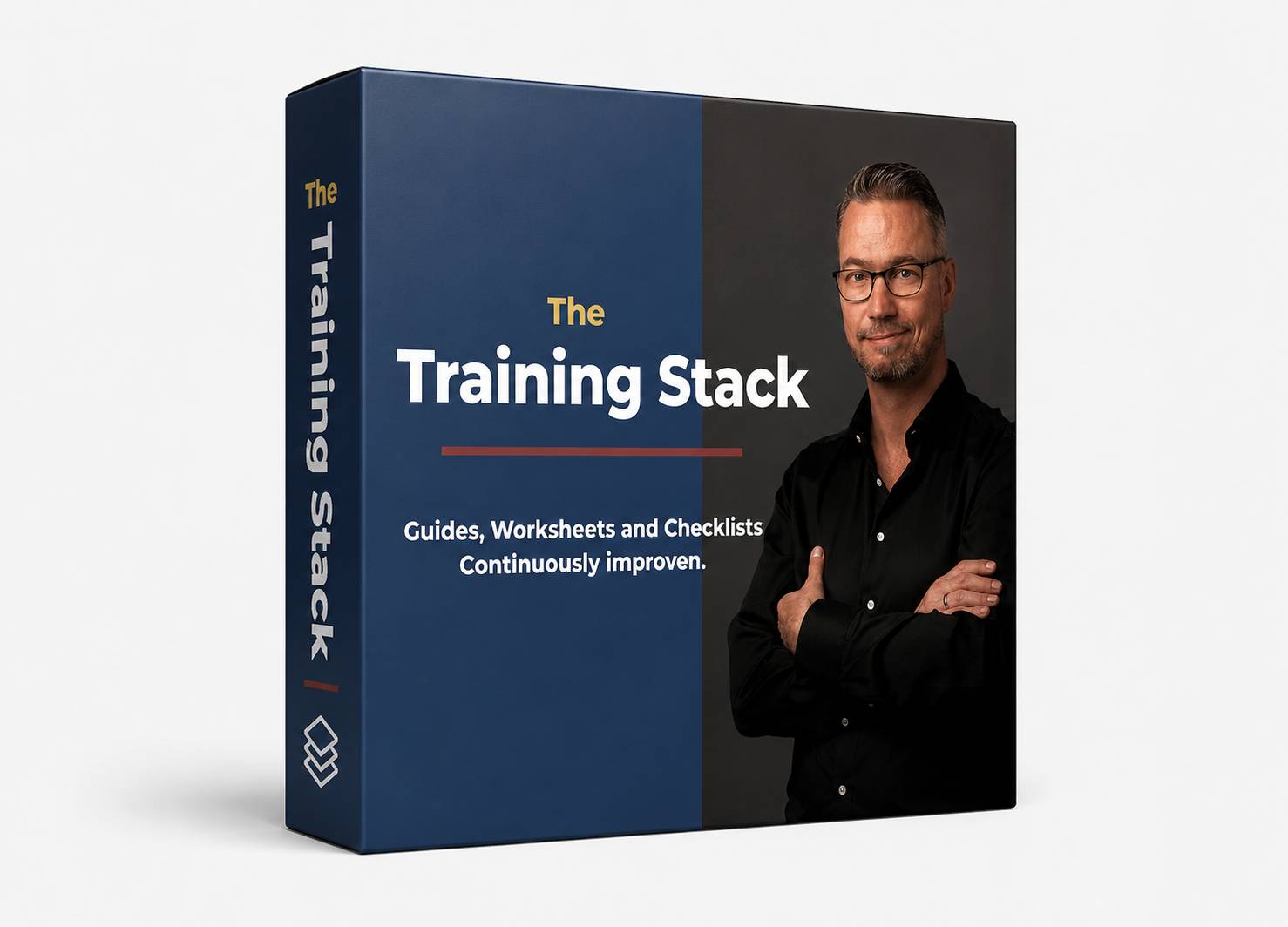
That broader perspective is also why my work increasingly revolves around developing structured bodies of knowledge instead of endlessly redesigning them for every new request. Projects come and go. Frameworks remain. In time they become part of a larger collection of ideas about how expertise can be organised, taught and improved. Training Stacks emerged from that line of thinking, not as a rejection of professional services but as an exploration of what happens when knowledge becomes deliberately structured before it is delivered.
 |
$129.99
PRESALE OFFER | The Training Stack
If you're serious about turning years of your experience into training that help others learn and grow, The Training... Read more |
The argument for fixed-scope offers is therefore larger than commercial efficiency. It is an argument for respecting accumulated expertise. It recognises that the purpose of experience is not to become endlessly adaptable but to discover what no longer needs adapting. There will always be situations that genuinely require bespoke work. They deserve it. The mistake is assuming that uniqueness should be the starting point rather than the conclusion.
When expertise becomes easier to buy, easier to deliver and easier to improve, everyone benefits. Clients receive something proven instead of merely promised. Professionals spend less energy reinventing and more energy refining. That feels like progress worth pursuing, even if one question remains open:
Perhaps organisations are not searching for custom work because they need it, but because they want reassurance that they have been seen.
Whether those two things should always be treated as the same is a question still worth thinking about.
